Cart (0)
Special offer at 50% off today

The Viral Butter Squishy
Squeeze it flat, it rises back.

The Ocean Cube Squishy
Cool gel, melts under your thumb.
Your cart is empty


Special offer at 50% off today :

The Coconut Oil Squishy
Press a dent in, it stays.

The Viral Butter Stick, in Pink
Squeeze it flat, it rises back.
Description
Ever notice how kids light up when they figure something out on their own? That moment of focus, the careful placement, the proud smile when the pattern clicks into place. That's what happens here, every single time.

This isn't just another toy that gets forgotten in a week. It's the kind of hands-on challenge that grows with your child, from simple shapes to complex designs that demand real concentration and planning.
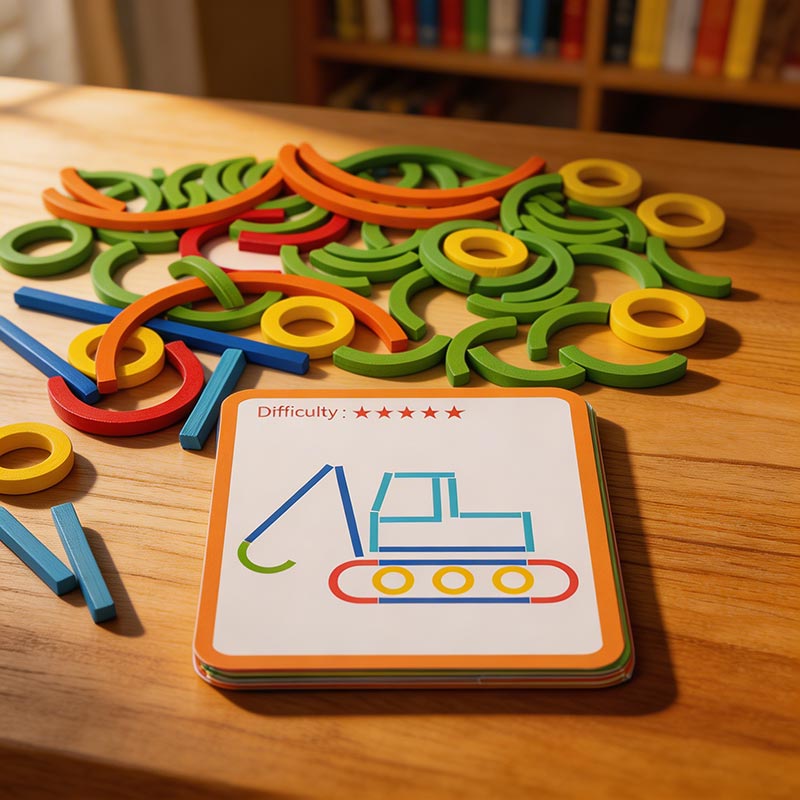
Inside, you'll find 120 colorful wooden sticks and rings, 20 double-sided challenge cards with varying difficulty levels, a wooden base to hold each card, and a handy pouch to keep everything together. Pick a card, study the pattern, then recreate it using the right pieces. Some designs take seconds, others require genuine problem-solving.
The beauty is in the simplicity. No batteries, no screens, no complicated rules. Just a child, a challenge card, and the satisfaction of building something that matches perfectly. The montessori toys approach shines through: children learn spatial reasoning, color matching, and fine motor control without realizing they're learning at all.
Turn it into a timed family challenge by sorting cards by difficulty and seeing who can complete the most patterns in five minutes. Suddenly, a quiet afternoon activity becomes a lively competition that everyone wants to join.

If you're looking for something that combines learning, creativity, and genuine engagement, this delivers all three. Ready to see what your child can build?


Product specification
How fast will it get here?
Payment and security
Secure payment by card, PayPal or Apple Pay. Your card details are encrypted and never pass through the store.

This is what happens when a toy respects a child's intelligence. Instead of flashing lights and sounds that do the thinking for them, your child gets real challenges that require focus, planning, and problem-solving. Each pattern card presents a new puzzle to solve, and the satisfaction of matching it perfectly keeps them coming back.
Parents notice the difference immediately: longer attention spans, genuine concentration, and that rare quiet where kids are actually learning something valuable. Whether they're working through beginner cards or tackling the complex patterns, they're building spatial reasoning and fine motor skills that matter beyond playtime.
What makes this special is how it adapts. A three-year-old focuses on simple shapes and color matching. A five-year-old tackles the intermediate patterns that demand planning. An older child races against the timer or invents entirely new designs beyond the cards.
The wooden pieces are built to last through years of use, and the challenge cards provide enough variety that you won't hear "I'm bored with this" after a week. It's the kind of toy that stays relevant through different ages and skill levels, making it a genuinely worthwhile investment rather than clutter that ends up in a donation box.


The wooden construction feels substantial the moment you open the box. These aren't flimsy plastic pieces that crack after a month. The wood is smooth, the water-based paint is applied evenly, and every piece is sized appropriately for safe handling by young children.
The included pouch keeps all 120 pieces organized, so you're not constantly hunting for lost sticks under the couch. Everything packs away neatly, and the compact size means it travels well for car trips or visits to grandparents. Easy maintenance is a bonus: a quick wipe with a dry cloth keeps everything clean and ready for the next round.
Here's what we love: this works beautifully as both independent quiet time and competitive family fun. When you need thirty minutes of peace, a child can work through pattern cards at their own pace. When everyone's together, sort the cards by difficulty and see who completes the most in five minutes.
Siblings at different ages can play together because the difficulty range is so wide. The youngest might work on simple shapes while an older child tackles complex architectural patterns. It's one of those rare toys that brings multiple ages together without anyone feeling left out or overwhelmed.
Questions before you buy
The cards range from very simple patterns perfect for a focused three-year-old up to complex designs that challenge elementary-aged kids. The difficulty system means it genuinely grows with your child rather than being outgrown in six months.
Younger children benefit from the fine motor practice and color matching. Older kids enjoy the puzzle-solving aspect and timed challenges. If your child can focus on a task for a few minutes and enjoys building or matching games, they're ready for this.
Place a challenge card in the wooden base so it stands upright. Your child looks at the pattern shown on the card and recreates it using the colored sticks and rings provided. Some patterns are straightforward, others require figuring out which pieces overlap or go where.
You can play it as calm, self-paced problem-solving, or add a timer and make it a race. Some families keep score across multiple rounds. Others just work through the cards one by one. There's no single right way, which is part of what makes it work for different families.
The included pouch is genuinely helpful here. Teach your child that cleanup means everything goes back in the pouch, and it becomes part of the routine. The pieces are sturdy enough that they won't break if stepped on, but yes, like any toy with multiple parts, it requires a bit of organization.
The upside is that nothing requires batteries, nothing makes noise, and nothing has parts that wear out or break easily. The trade-off for having 120 pieces is that you get enormous variety and replayability.
Absolutely, and many do once they've worked through the provided challenges. The sticks and rings become open-ended building materials for houses, animals, abstract art, or whatever they imagine. The cards provide structure when kids want it, but the pieces work beautifully for creative free play too.
This dual nature is what keeps it interesting long-term. Some days they follow the cards, other days they invent. Both types of play build valuable skills.

You may also like


